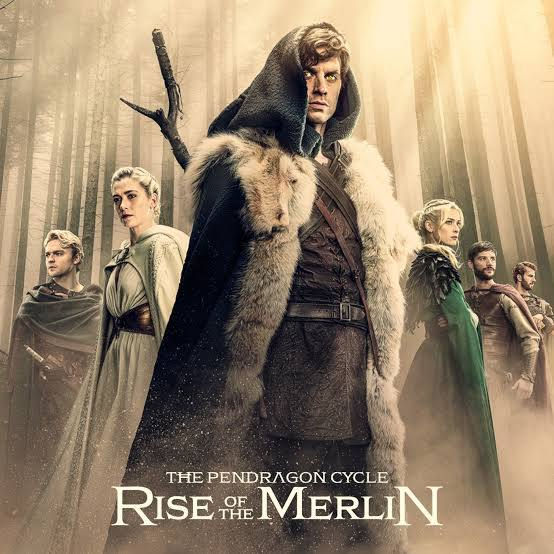
The Pendragon Cycle: Rise of the Merlin Review — Myth Remembered, Not Merely Retold
Updated: 1 day ago
There is a fundamental difference between adapting a fantasy novel and understanding the mythology that made the novel worth adapting in the first place. The Pendragon Cycle: Rise of the Merlin understands that difference.
Created by Jeremy Boreing and drawn from Stephen R. Lawhead’s Pendragon Cycle, particularly Taliesin and Merlin, the seven-part series undertakes an unusually difficult act of translation. Lawhead’s novels are not simply Arthurian adventures. They are an attempt to excavate Arthur from beneath centuries of accumulated romance, chivalric convention, Victorian medievalism, and popular iconography, and then rebuild the legend within the cultural instability of post-Roman Britain. Boreing and fellow directors Ryan Whitaker and Jesse V. Johnson inherit that same challenge for the screen. What makes Rise of the Merlin remarkable is that it recognizes the central intellectual proposition of Lawhead’s work: Arthurian mythology becomes more powerful, not less, when it is placed close enough to history that we can imagine it might once have been true.
That is the series’ great achievement.
Most contemporary fantasy adaptations are preoccupied with the mechanics of world-building. They explain kingdoms, armies, bloodlines, magic systems and political alliances until the audience understands precisely how the fictional universe operates. Rise of the Merlin is interested in something older. It wants us to feel how a civilization explains itself before explanation becomes history.
That distinction matters.
Lawhead’s Britain occupies a threshold between epochs: Rome has receded, Christianity is taking root, ancient religions have not yet relinquished their psychological hold, tribal identities compete with the idea of national unity, and history itself feels unstable. The television adaptation preserves that liminality. This is not the familiar Arthurian England of plate armor, tournaments and Gothic castles. It is a harsher, stranger Britain—a Britain still deciding what Britain is. The production deliberately situates the story in the world following Roman occupation rather than the much later medieval period usually associated with Arthurian imagery.
And therein lies one of the smartest aspects of Boreing’s adaptation: the series does not merely reproduce Lawhead’s plot. It preserves Lawhead’s historical imagination.
The connection to Taliesin, the first book in Lawhead's saga, is particularly important because the series refuses the temptation to rush toward the marketable icons of Arthurian legend. There is no desperate scramble to reach Camelot. Instead, the story begins generations earlier—with Taliesin, Charis, Atlantis, prophecy, belief and cultural collapse—before moving toward Merlin and ultimately toward the image of the sword in the stone. The official description itself makes explicit that trajectory: the series begins with the child who will become Taliesin and closes with one of the defining images of Arthurian mythology.
It is an audacious structural choice because it asks the audience to understand Arthur before Arthur exists.
But that was precisely Lawhead’s point.
Kings do not emerge from nowhere. Legends have genealogies and civilizations produce the myths they require.
By foregrounding Taliesin and Charis - Merlin's parents - Rise of the Merlin transforms Merlin from the eccentric wizard standing beside Arthur into something considerably more interesting: a man who is himself the consequence of collapsing worlds. His inheritance is cultural, theological and emotional long before it becomes supernatural. He belongs simultaneously to what is disappearing and to what has not yet arrived.
That is where the series becomes more than an origin story.
It becomes a meditation on inheritance.
The Adaptation Understands Lawhead’s Theology of Myth
Perhaps the most intellectually confident decision made by the filmmakers is their refusal to strip the story of its metaphysical seriousness. Religion in Rise of the Merlin is not decorative medieval furniture. Belief has consequences. The conflict between older gods and Christianity is therefore not treated simply as a historical transition in which one religious system replaces another. It becomes a contest between understandings of reality itself—between power and providence, fate and vocation, darkness and revelation.
Boreing has spoken of wanting to retain the visceral quality of Lawhead’s Christianity rather than making the world cleaner or safer for contemporary audiences. That instinct proves essential because sanitizing the religious dimension of The Pendragon Cycle would be equivalent to adapting Tolkien while politely removing all concern with providence, mortality and moral corruption. The narrative might remain, but the architecture beneath it would collapse.
Instead, faith here is difficult. It arrives in a violent world and it demands something of people. Characters do not merely possess beliefs; their beliefs alter the trajectory of their lives. This is also where Rise of the Merlin understands something many modern fantasy productions have forgotten: mystery is not the enemy of intelligence. A story does not have to explain away transcendence in order to be sophisticated. Sometimes the more demanding artistic choice is allowing characters to encounter something beyond their ability to fully comprehend.
Merlin Before the Wizard
Tom Sharp’s Merlin benefits enormously from this approach because the character is freed from the accumulated theatrical mannerisms that have attached themselves to Merlin over centuries of adaptation.
The Merlin of popular culture is immediately recognizable: elderly, eccentric, omniscient, frequently comic, usually mysterious because the plot requires him to be.
Lawhead’s Merlin is something else entirely.
So is Sharp’s.
He is wounded before he is wise.
The series allows prophecy to resemble burden rather than superpower. Knowledge does not make Merlin comfortable within the world; it frequently estranges him from it. His authority therefore develops less from spectacle than from suffering.
That distinction gives the character gravity.
One of the subtler accomplishments of the adaptation is that Merlin feels ancient without becoming static. He exists in the peculiar temporal condition of legendary figures: simultaneously man and memory, participant and narrator, individual and archetype.
Sharp understands the danger of playing such a character too loudly. His strongest work comes from giving Merlin an interior life large enough that silence itself begins to feel inhabited. Around him, the ensemble creates the impression of history arriving from several directions at once. Rose Reid’s Charis is especially important because she cannot function merely as a genealogical bridge between Atlantis, Taliesin and Merlin. The narrative requires her to embody the psychological devastation of surviving one civilization while helping to give birth to another. James Arden’s Taliesin, likewise, has to exist somewhere between poet, prophet and man—a balance essential to understanding the bardic conception underlying Lawhead’s mythology.
And Colin Cunningham’s work as Vortigern deserves particular notice. His performance received the 2026 Leo Award for Best Lead Performance in a Dramatic Series, but the achievement goes beyond force of personality. He understands that a compelling historical antagonist must believe that power is simply another name for reality.
A Visual Language of Ruins, Wilderness and Becoming
Shot on location in Hungary and Italy, Rise of the Merlin frequently achieves something more valuable than visual extravagance: physical credibility. Forests, settlements, stone, mud, mountains and fortifications do not feel like interchangeable fantasy backdrops because the world itself appears to be participating in the historical transition at the center of the story. Civilization feels provisional. Nature still dwarfs human ambition. Buildings seem capable of becoming ruins almost as soon as they are constructed.
That visual impermanence is entirely appropriate for Arthurian mythology.
Arthur’s tragedy, after all, is inseparable from the idea that even the greatest kingdom cannot permanently resist time.
The cinematography by Kris Kimlin, Akis Konstantakopoulos and Maxime Alexandre frequently treats landscape not merely as geography but as psychological space, while Renátó Cseh’s production design and the costume work by András Dániel Tôth and Attila Godena-Juhász help resist the polished artificiality that can make historical fantasy feel manufactured.
Kyle McCuiston’s score performs a similarly important function. It understands that Arthurian music should not simply tell us when something is heroic. It must suggest memory—a civilization hearing the faint beginnings of the song by which later generations will remember it.
The Intelligence of Compression
There are moments when the density of the material can be demanding. Generations pass. Civilizations intersect. Theology, prophecy, warfare, political fragmentation and intimate tragedy compete for space within seven episodes.
Yet some of that compression is inseparable from the ambition of the project.
A lesser adaptation might have simplified Lawhead by choosing only the recognizable Arthurian components. Rise of the Merlin largely chooses the opposite strategy: it preserves the strange connective tissue.
Atlantis matters. Taliesin matters. Charis matters. The religious transformation of Britain matters. The Saxon threat matters. The bards matter. The idea of Britain matters before the kingdom of Britain exists. Consequently, viewers are occasionally required to meet the series halfway. I consider that a virtue more often than a liability. Contemporary television has become so conditioned to repeating information that narrative confidence can initially feel like narrative difficulty. Rise of the Merlin assumes its audience can remember names, interpret symbols and understand that mythology does not always unfold according to the rhythms of conventional episodic drama.
That confidence should be encouraged.
What Boreing Gets Right About Adaptation
Perhaps the most impressive element of Jeremy Boreing’s work is something easy to overlook: he understands that fidelity is not the same thing as transcription. An adaptation can reproduce every event in a novel and nevertheless betray it. Another can alter chronology, combine incidents or compress characters while remaining profoundly faithful to the author’s imaginative purpose. The question is not merely, Did this happen exactly this way in the book? The more important question is:
Does this feel as though it belongs to the same moral and imaginative universe?
Again and again, Rise of the Merlin does.
Boreing spent more than two decades attempting to bring Lawhead’s novels to the screen, according to the production’s press materials, and that long familiarity is visible not simply in reverence for the source but in an understanding of what can safely be altered and what cannot.
The mythology cannot be reduced to just Arthur.
The Christianity cannot be removed without fundamentally rewriting Lawhead.
Merlin cannot simply become a magician.
Taliesin cannot merely become backstory.
Britain cannot merely become scenery.
Once those principles are understood, adaptation becomes considerably more interesting.
Before There Was a King, There Had to Be a Story
There is an extraordinary irony at the heart of Arthurian storytelling: nearly everyone knows the ending. And yet generation after generation returns to the story.
Why?
Because Arthurian legend has never truly been about suspense. It is about longing. The longing for the just king. For a civilization capable of becoming better than the people who created it. For wisdom powerful enough to restrain violence. For unity strong enough to survive human ambition. For the possibility that history, however briefly, might become worthy of legend. Stephen R. Lawhead understood that yearning when he began The Pendragon Cycle. Rise of the Merlin understands it too.
And that is ultimately why the series succeeds so powerfully when it is at its best. It does not treat Arthurian mythology as intellectual property waiting to be modernized. It treats it as cultural memory—something inherited, argued with, reshaped and handed forward.
Jeremy Boreing, Ryan Whitaker and Jesse V. Johnson have created a work that is simultaneously adaptation, historical fantasy and mythmaking. Its greatest accomplishment is not that it makes Lawhead cinematic.
It is that it recognizes what Lawhead was doing all along.
He was not simply retelling the story of Arthur.
He was asking how history becomes legend.
The Pendragon Cycle: Rise of the Merlin answers with an equally compelling proposition: First, someone survives. Then someone remembers. Then someone tells the story. And, eventually, history becomes myth.
That is where Merlin has always lived.
And for perhaps the first time in a very long while, an Arthurian adaptation seems to understand exactly why.


Comments