Film Review - A Short Documentary About a Giant Pencil
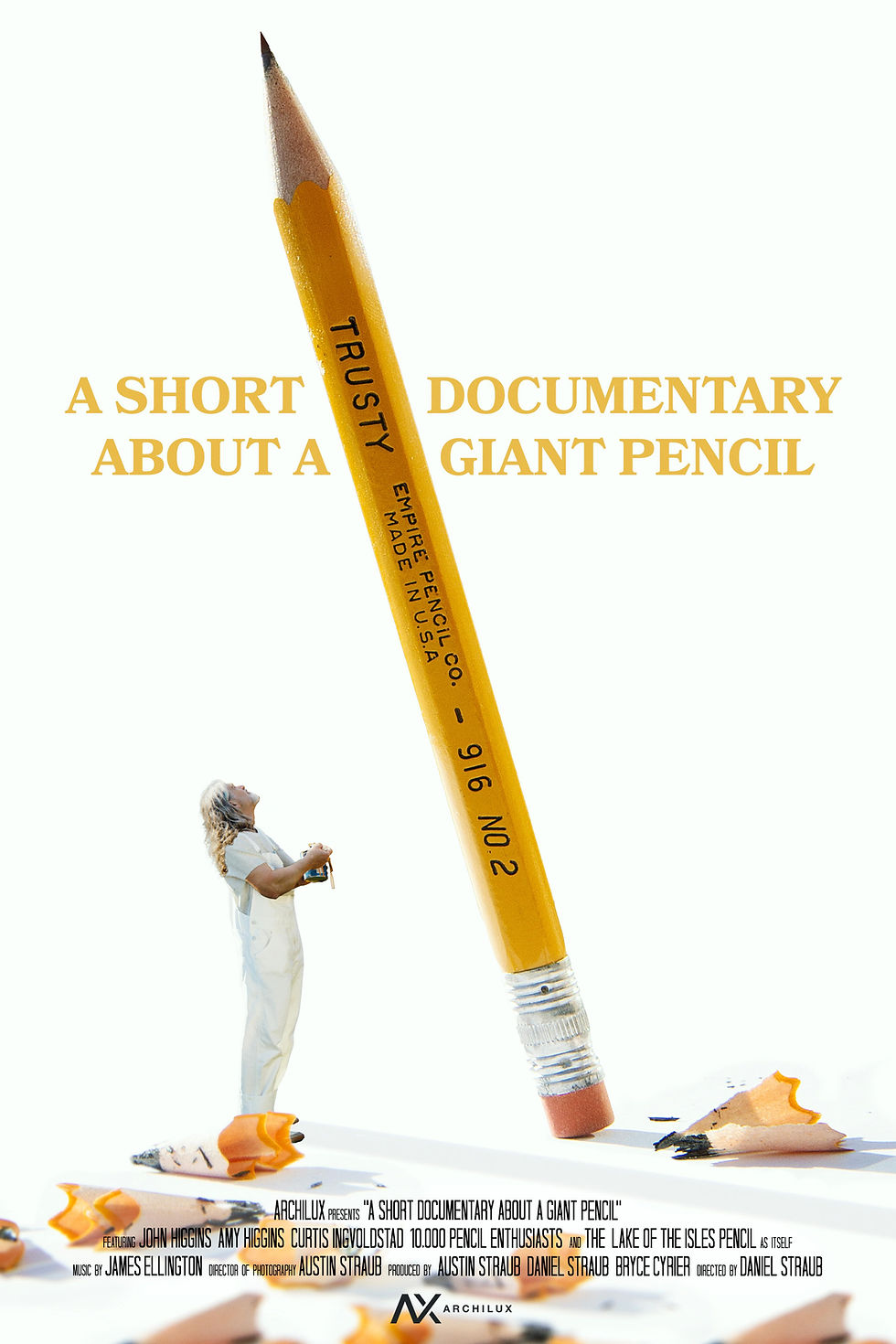
There is something wonderfully disarming about A Short Documentary About a Giant Pencil. Its title promises exactly what it delivers—a documentary about an enormous pencil—but Daniel Straub’s film gradually reveals that the object itself is almost beside the point. What begins as an eccentric story about transforming the twisted remains of a fallen oak tree into a twenty-foot No. 2 pencil becomes a warm, unexpectedly thoughtful examination of art, impermanence, ritual, and the peculiar ways communities find reasons to come together.
The film succeeds because it never appears embarrassed by the absurdity of its subject. Instead, it embraces that absurdity with affection. A giant pencil sitting beside Minneapolis’ Lake of the Isles is inherently funny, but Straub understands that whimsy and sincerity are not opposites. The sculpture becomes meaningful precisely because people decide that it is meaningful. What began with homeowners John and Amy Higgins and sculptor Curtis Ingvoldstad has evolved into a genuine local tradition, with thousands gathering for the pencil’s annual sharpening.
That ritual provides the documentary with its most compelling idea. Each sharpening deliberately removes part of the sculpture, meaning that the very celebration responsible for sustaining the pencil as a community landmark is also slowly consuming it. There is something unexpectedly beautiful in that contradiction. The pencil is not designed to remain untouched forever; its deterioration becomes part of its purpose. The annual ceremony transforms impermanence into participation, suggesting that the value of art may reside less in preserving an object than in the experiences and relationships created around it.
Straub approaches the material with an appropriately light touch. The film never seems interested in forcing the pencil into becoming a grand metaphor. Instead, meaning emerges organically from the people who created it and the community that adopted it. That restraint keeps the documentary from becoming overly sentimental while allowing its more emotional ideas—creation following destruction, collective memory, and the desire to “do something”—to resonate naturally.
Visually, the film benefits enormously from the eccentric scale of its subject. Austin Straub’s cinematography has the opportunity to contrast the ordinary residential environment with an object whose proportions are joyfully ridiculous. The film was photographed and presented in a 1.43:1 aspect ratio the filmmakers jokingly dubbed “Ultra Pencilvision,” an example of how completely the production embraces the personality of its subject.
If the film has a limitation, it is almost inseparable from its charm. The story is deliberately modest, and viewers expecting a more traditionally dramatic documentary arc may find its conflict relatively slight. Yet imposing additional drama would arguably work against what makes the film distinctive. Its achievement lies in recognizing that something does not need to be historically monumental to reveal something meaningful about human beings.
At only twenty-two minutes, A Short Documentary About a Giant Pencil manages the rare feat of being both genuinely funny and unexpectedly moving. It celebrates the strange little traditions people create together and the way an object can become important simply because a community chooses to gather around it.
Ultimately, the film is not really about a giant pencil. It is about what happens when someone looks at the remains of something destroyed and imagines what it might become next—and then discovers that other people want to be part of that transformation too.
It is difficult to imagine a more fitting documentary about a pencil: charming, sharply observed, and very much to the point.


Comments